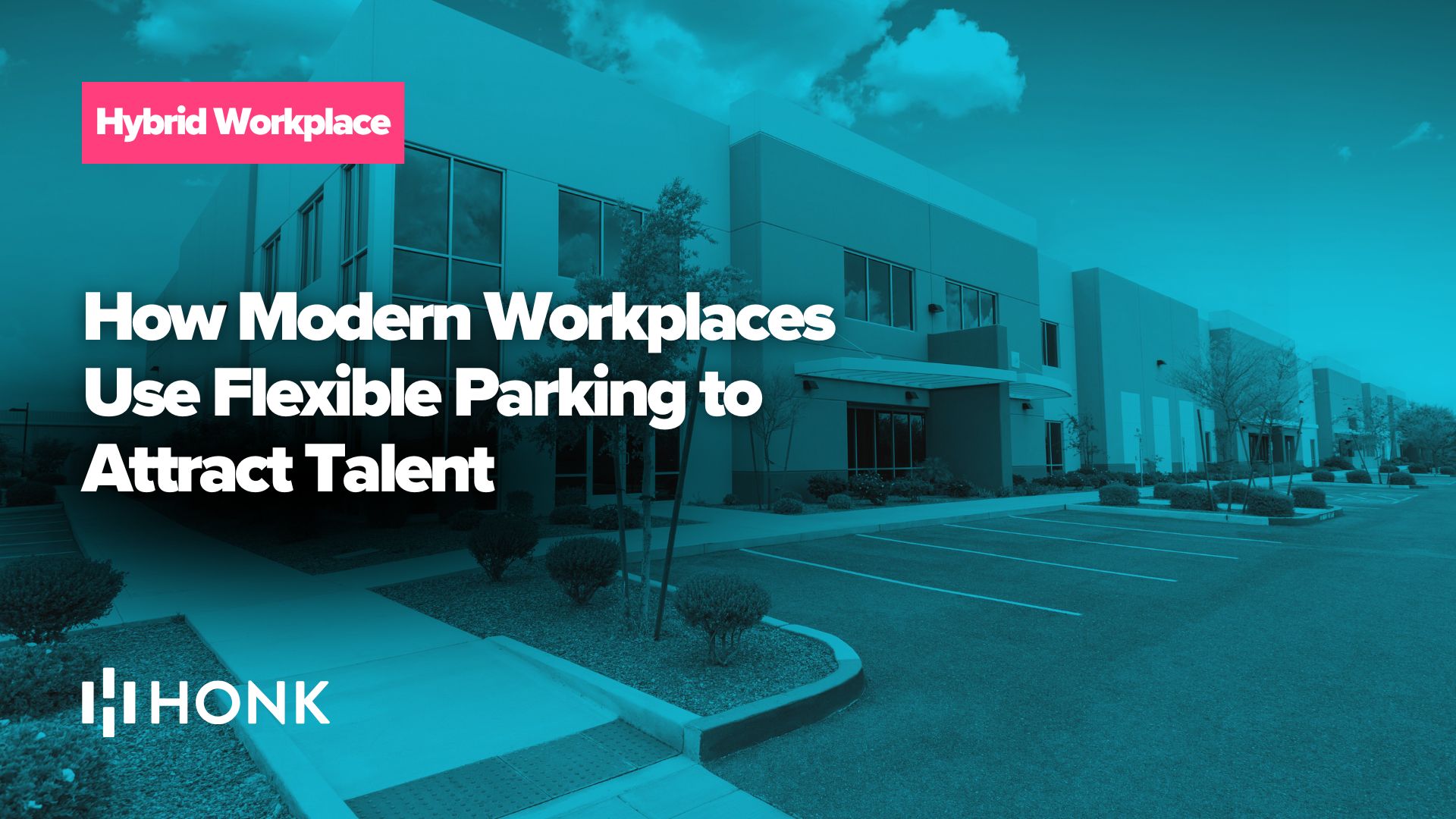
The rules of work have changed. Hybrid schedules mean employees don’t commute five days a week anymore. Some come in Tuesdays and Thursdays. Others show up for all-hands meetings and skip the rest. The old model of assigned parking spots sitting empty three days a week doesn’t make sense, and companies are realizing that parking can be more than just a space. It can be a strategic advantage in the war for talent.
When 74% of hybrid companies report fluctuating daily parking demand, the question isn’t whether to adapt. It’s how to make parking work as hard as every other employee benefit in your arsenal.
The New Reality: Parking Meets the Hybrid Workplace
Remember when showing up to the office meant circling the lot at 8:45am, hoping someone called in sick so you could snag their spot? That daily frustration hasn’t disappeared, it’s just gotten more complicated. Now you’ve got employees who only come in twice a week competing with those who show up Monday through Friday, and nobody knows who’s going to be there until the day before.
Traditional parking management was built for predictability. You assigned spots based on seniority or department, and everyone knew where they belonged. But hybrid work killed predictability. Studies show average corporate parking occupancy dropped to just 2% during some hours, even while employees complained about shortages during peak times. Those expensive reserved spots sit empty when remote workers stay home, but they’re unavailable for colleagues who actually showed up.
This creates a lose-lose situation. Employees waste time hunting for spaces or arrive early just to secure parking. Companies pay for real estate that sits unused most of the time. And nobody’s happy about it.
Why Parking Actually Matters for Talent Retention
It’s easy to dismiss parking as a mundane operational detail. But here’s what the data tells us: 68% of employees who left their jobs in 2024 cited engagement and culture or wellbeing and work-life balance as the primary reasons, not pay. And nothing kills work-life balance faster than showing up for your hybrid workday only to spend 20 minutes circling the lot because someone in a reserved spot decided to work from home.
Parking affects the employee experience from the moment they leave their house. It’s the first impression of their workday and often the last thing they remember when they leave. Make it frustrating, and you’re starting every in-office day on the wrong foot. Make it seamless, and you’ve removed one more point of friction that might push someone to look elsewhere.
Companies spend significant resources on perks like wellness programs, professional development, and flexible work arrangements. According to the IRS, employers can exclude up to $315 per month per employee for qualified parking benefits from taxable income. That’s not a small number, but it only matters if you’re using parking strategically rather than letting it languish as an outdated system.
Consider this: in high-cost cities like New York, Los Angeles, or San Francisco, employees can spend over $9,000 annually on parking. If you’re asking people to come into the office but making them scramble for expensive parking, you’re essentially charging them to comply with your hybrid policy. That doesn’t exactly scream “we value your contribution.”
Enter Flexible Parking Solutions
The smartest companies aren’t just managing parking, they’re reimagining it as a benefit that adapts to how people actually work. This is where solutions like HONK’s FlexPass and similar digital parking platforms come into play.
Here’s how it works: instead of assigning permanent spots that sit empty half the week, you create a flexible pool. Employees book parking when they need it, through a mobile app or web platform, and release it when they’re working remotely. The system handles everything: reservations, payments, access control, without requiring staff to play parking lot referee.
This isn’t some far-off concept. Universities have been doing this for years with HONK’s platform. Students and faculty purchase FlexPass packages (essentially prepaid parking credits at a discount) and redeem them when they’re on campus. The model works because it matches parking supply to actual demand rather than guessing who’ll show up.
For companies, the benefits are immediate. You maximize utilization of existing spaces, which means you might not need that expensive new parking structure you were considering. Employees get guaranteed parking on the days they come in, which reduces stress and wasted time. And you’ve created a tangible perk that directly addresses a pain point in the hybrid work experience.
Making Parking Part of Your Employee Value Proposition
The best part? Flexible parking solves multiple problems at once. You’re not just managing spots more efficiently, you’re sending a message that your organization understands how people work now and is willing to adapt.
Think about your recruitment pitch. You can truthfully say: “We offer guaranteed parking on the days you’re in the office, with flexible booking that matches your schedule.” That’s a concrete benefit that differentiates you from companies still operating with 1990s parking policies.
Some companies take it further by offering parking stipends alongside their flexible booking systems. Rather than covering monthly passes that might go unused, they give employees credits to spend on parking when they actually need it. This approach respects the reality that not everyone needs parking every week, and it puts money back in employees’ pockets when they’re remote.
The tax benefits sweeten the deal. Because qualified parking falls under pre-tax commuter benefits up to $315 monthly, employees save on taxes while employers save on payroll costs. Combined with modern mobile parking payments, it’s one of those rare situations where everyone wins.
Hot-Desking for Parking Spots
If you’ve embraced hot-desking for workspaces, why not apply the same principle to parking? The logic is identical. You don’t need a desk for every employee if only 60% come in on any given day, and you don’t need a parking spot for every employee either.
Digital platforms make this possible in ways that spreadsheets and email never could. Employees open an app, see real-time availability, book a spot for the day or week, and get confirmation instantly. Some systems integrate with building access control, so your parking reservation automatically grants you gate access or elevator permissions.
This creates a seamless experience. You book your desk and parking in the same app, you know exactly where to go when you arrive, and you’re not wasting mental energy on logistics. For companies managing multiple office locations, this becomes even more valuable. An employee working from your downtown office on Tuesday and your suburban campus on Thursday can book appropriate parking at each location without involving facilities staff.
The data piece matters too. With real-time parking analytics, you can see patterns: which days have highest demand, which locations are underutilized, whether your current parking capacity actually matches need. This helps you make smarter decisions about real estate, lease negotiations, and capital investments.
Revenue Sharing: A Bonus for Everyone
Here’s an underrated feature of modern parking platforms: employees can release their spots for others to book, sometimes earning a small fee in the process. If you have a monthly parking contract but you’re working from home this week, why shouldn’t someone else use that spot, and why shouldn’t you get a cut?
Companies benefit because utilization increases, parking operators capture revenue they would have missed, and employees feel like they have more control and flexibility. It’s a win-win-win that wasn’t possible with traditional reserved parking.
Organizations using platforms like HONK have seen this play out successfully. Property management companies report adding revenue streams they didn’t have before, simply by enabling temporary parking access for guests, contractors, or employees from other buildings who need overflow parking.
Practical Implementation: Making the Shift
Moving from traditional to flexible parking doesn’t require ripping up your entire parking lot. Start small. If you have 100 spots and 120 employees, acknowledge that not everyone needs parking simultaneously. Survey your team to understand actual demand patterns: how many days per week they’re in office, whether they need guaranteed parking or can be flexible, what times they typically arrive and leave.
Most companies find that 60-70% of their workforce is in the office on any given day under hybrid arrangements. That means you can confidently support more employees than you have spots, as long as you have a booking system to prevent conflicts.
Pick a digital platform that integrates with your existing systems. Cloud-based parking management solutions handle the logistics so you don’t need to hire someone to manage reservations manually. Look for platforms that offer mobile apps, contactless payments, and real-time updates (features your employees already expect from every other digital service they use).
Communication matters. When you roll out flexible parking, frame it as an upgrade, not a takeaway. Emphasize the benefits: no more circling the lot, guaranteed spots when you book, the ability to plan ahead. Make sure leadership uses the system too. Nothing undermines adoption faster than executives keeping their reserved spots while everyone else uses the new system.
Consider offering different tiers. Maybe senior leaders or employees with specific needs (think someone with a disability or someone who regularly transports equipment) get priority booking. Everyone else uses the flexible pool. The key is transparency: people need to understand the rules and feel like they’re fair.
Competitive Advantage in Talent Markets
When you’re competing for talent with companies offering similar salaries and benefits, small differentiators matter. Flexible parking might not top the list of reasons someone accepts a job offer, but it contributes to the overall picture of a company that gets modern work.
Gen Z and millennial employees especially value flexibility and autonomy. They want to feel trusted to manage their own schedules and logistics. A parking system that lets them book on their terms, see real-time availability, and adjust plans as needed aligns with those values. It’s not just about the parking, it’s about the philosophy behind it.
Plus, in markets where parking is expensive or scarce, this benefit has real dollar value. In San Francisco, monthly parking can run $400-$500. If you’re subsidizing that or offering flexible credits, you’re providing meaningful financial support. Highlight this in your recruitment materials and retention conversations.
Looking Forward: Parking in the Flexible Future
The shift to flexible parking reflects a broader trend: companies are rethinking every aspect of the office experience for a hybrid world. Just as we’ve moved from assigned desks to hoteling, from fixed schedules to core hours, parking is evolving from permanent assignments to dynamic allocation.
This matters because the office itself is changing. We’re not going back to everyone showing up Monday through Friday, 9 to 5. That ship has sailed. The offices that thrive will be the ones that embrace flexibility at every level, including parking.
Smart parking solutions using platforms like HONK are already making this possible. The technology exists. The question is whether your organization will adopt it proactively or wait until parking frustration becomes a retention problem.
Making It Happen
If you’re still managing parking with reserved spots and paper permits, you’re overdue for an upgrade. The companies that figure out flexible parking now will have a leg up in attracting and retaining talent over the next few years. Those that don’t will find themselves explaining to frustrated employees why they’re stuck in outdated systems while competitors offer modern solutions.
Start by assessing your current parking situation. How many spots do you have? What’s actual daily utilization? What are employees saying about parking in surveys and exit interviews? Armed with that data, you can build a business case for flexible parking that speaks to both employee experience and operational efficiency.
Then find the right partner. We’ve built our platform to handle exactly this challenge: flexible booking, contactless payments, real-time management, and seamless integration with your existing systems. Whether you’re managing parking for 50 employees or 5,000, the principles are the same: make it easy, make it fair, and make it flexible.
Parking shouldn’t be a pain point in the hybrid work era. With the right approach and tools, it can be an amenity that helps you compete for talent, supports your culture, and demonstrates that your organization understands how people actually want to work. That’s worth investing in.