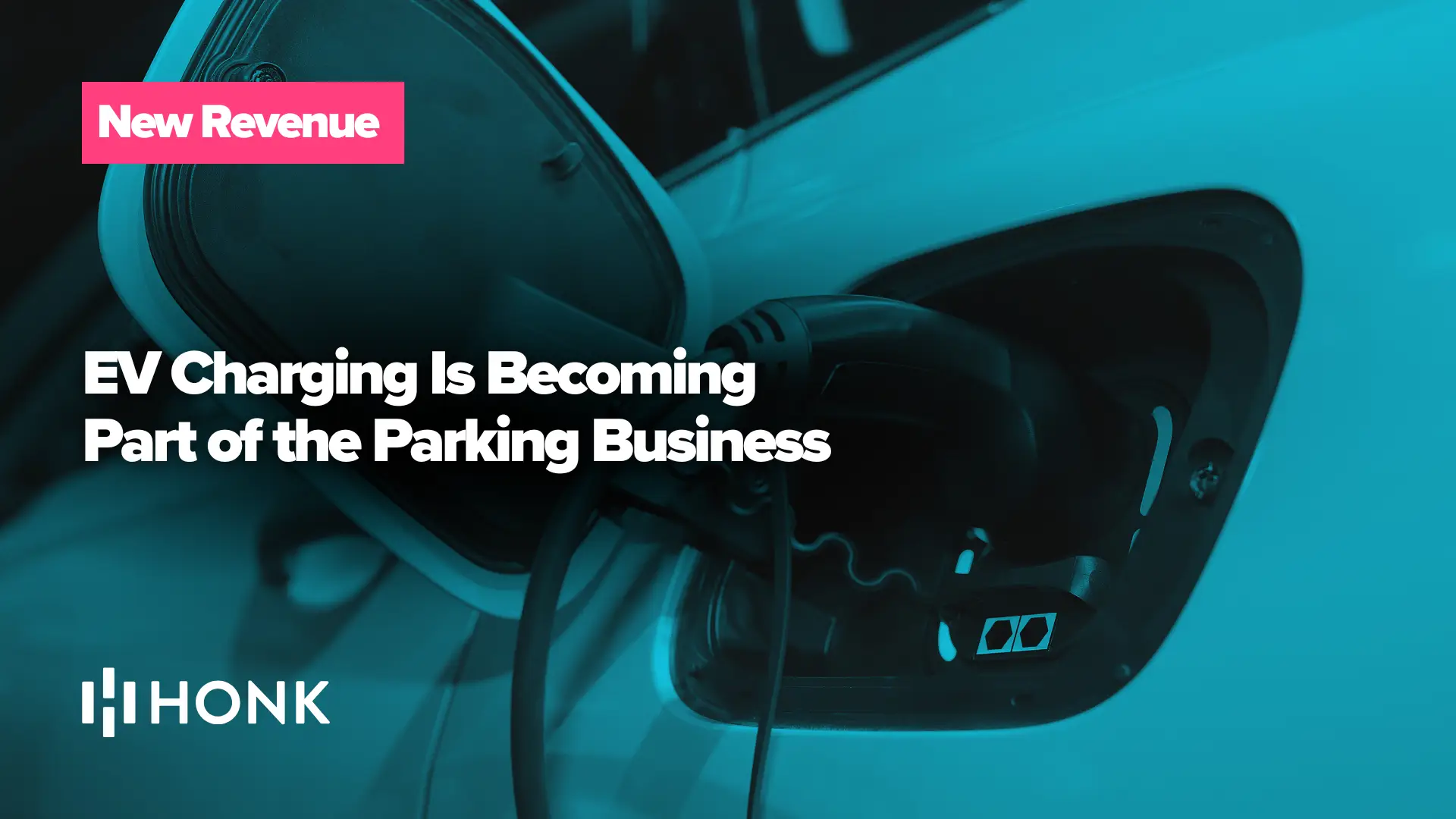
Parking operators are already dealing with tighter margins, changing driver expectations, and more pressure to get better revenue from the same spaces. Now electric vehicle charging is adding another layer to the operation. Drivers are not just looking for a place to park. More of them are looking for a place where parking time can also become charging time.
That shift matters because EV charging is not just an amenity. When it is planned correctly, it can become a revenue stream, an occupancy driver, and a data source that helps operators understand how their facilities are being used. The operators who treat chargers as part of the parking experience will have a stronger advantage than the ones who treat them like a separate piece of equipment sitting in the corner of the lot.
At HONK, we see parking as more than a transaction. It is a daily operating system for cities, campuses, venues, private operators, airports, mixed-use properties, and commercial garages. EV charging fits into that same system because it affects pricing, dwell time, space management, enforcement, reporting, and the driver experience.
Why EV Charging Creates a New Revenue Opportunity
The most obvious revenue opportunity is direct charging revenue. Drivers can pay for the electricity they use, either by time, by energy consumed, or through a charging session fee. For parking operators, that creates a second transaction layered on top of the original parking session.
The better opportunity, though, is often bigger than the charging session itself. EV charging can help increase dwell time, attract higher-intent parkers, and make a facility more competitive when drivers are choosing between nearby parking options. If two garages are similarly priced and one lets a driver charge while parked, the charger becomes a reason to choose that location.
That is where parking strategy matters. A charger by itself does not automatically improve revenue. The operator still needs to think through pricing, space access, session rules, enforcement, payment flow, and how the charging experience connects to the broader parking operation. This is where a connected parking platform becomes important because operators need visibility into what is happening across the full facility, not just at the charger.
Charging Revenue Is Not Always One Size Fits All
Some operators will want EV charging to function as a direct revenue stream. In that model, the driver pays for parking and then pays separately for the charging session. This approach works well when the facility has clear charging demand, strong dwell time, and enough utilization to justify the added equipment and operating costs.
Other operators may use charging as an occupancy driver. In this model, charging may be included, discounted, or priced close to cost because the real value is getting more drivers into the lot. That can make sense for retail, hospitality, campus, medical, municipal, and mixed-use locations where the goal is not only charging revenue, but stronger utilization of the parking asset.
Many parking operations will land somewhere in the middle. An operator might offer a short complimentary charging window, then apply a fee when a driver stays too long. Another facility might charge a premium for EV spaces during high-demand periods and lower that premium when occupancy drops. HONK’s view is simple: the right model depends on the facility, the customer base, and the data behind actual usage.
Dwell Time Is the Real Advantage
Parking operators already know that dwell time matters. A facility with short stays behaves very differently from a facility where drivers park for several hours. EV charging makes dwell time even more important because the value of the charging session depends on how long a driver is likely to remain parked.
Level 2 charging is often a strong fit for parking environments because many drivers are already staying long enough to receive a useful charge. Office garages, campuses, hotels, hospitals, downtown lots, commuter facilities, and event venues can all have dwell patterns that support charging. In those settings, the charger does not need to behave like a gas station. It can work with the natural rhythm of the parking stay.
Fast charging has a different role. It can be useful in high-turnover locations where drivers expect a shorter stop, but it usually brings higher equipment, installation, and utility requirements. That does not make it wrong. It just means operators should match the charger type to the use case instead of assuming the fastest option is always the best business decision.
Why Standalone Charging Creates Blind Spots
A common mistake is treating EV charging as a standalone vendor project instead of a parking operations decision. When the charging system is disconnected from parking payments, occupancy data, enforcement, and reporting, the operator gets a fragmented view. The charger may be collecting information, but that information is not helping the team manage the full facility.
That creates practical problems. Operators may not know whether EV spaces are being used by active charging customers or by drivers who are simply occupying a premium space. They may not know how long charging customers are staying compared with non-charging customers. They may also have to reconcile charging reports separately from parking revenue reports, which adds unnecessary administrative work.
HONK helps operators think about these problems through the lens of connected parking. If a facility already uses digital payments, real-time session data, rules, reporting, and enforcement integrations, EV charging should not sit outside that structure. It should feed into the same operational picture so the team can make better decisions with fewer disconnected systems.
The Payment Experience Still Matters
Drivers do not want a complicated payment process just because they are using an EV charger. They want the same thing every parker wants: a fast, clear, mobile-friendly experience that does not make them download an app they do not want or stand at a machine that does not work. If the charging experience feels clunky, the operator risks turning a premium amenity into another point of friction.
This is one reason HONK focuses so heavily on flexible mobile payments. Parking operators need payment tools that fit the way people actually behave. Some drivers want to use a stored payment method. Some want Apple Pay or Google Pay. Some want to scan a QR code and finish the transaction without creating an account.
That flexibility matters even more when EV charging is involved. A driver may already be dealing with a charging cable, a parking zone, a time limit, and a destination they are trying to reach. The payment flow should make that easier, not harder. HONK’s approach to Guest Checkout is built around that same idea: reduce friction so more drivers complete the payment process and fewer sessions become customer service issues.
Pricing Should Reflect Demand
EV charging spaces are not standard parking spaces. They have more infrastructure behind them, they may attract a different kind of demand, and they can become scarce during peak periods. If operators price them exactly like every other space at every time of day, they may miss the chance to manage demand properly.
This does not mean every EV space needs to be expensive. It means pricing should reflect the value of the space, the cost of operating the charger, the demand pattern of the facility, and the behavior the operator wants to encourage. If a driver is actively charging for two hours while visiting a business, that may be valuable usage. If a driver stays all day after charging is complete, that may create a turnover problem.
HONK’s work around dynamic pricing applies directly to this issue. Operators need the ability to adjust rates, rules, and offers based on real demand. EV charging can become part of that pricing strategy when charging spaces are managed as premium inventory instead of treated as fixed, static spaces.
EV Charging Can Improve Enforcement
EV charging also creates enforcement questions that operators need to solve early. What happens when a non-EV parks in a charging space. What happens when a driver plugs in but does not pay. What happens when charging ends but the vehicle stays parked for several more hours. These are not small details because unmanaged charging spaces can quickly become a source of frustration for drivers and staff.
The answer is not always more signage or more manual monitoring. Operators need rules that can be enforced consistently, and they need data that shows whether a vehicle is authorized to use the space. When parking sessions, payment status, license plates, and rules are connected, enforcement becomes much easier to manage.
This is where HONK’s broader parking infrastructure matters. The same platform thinking that supports payments, permits, validations, and enforcement can help operators create smarter EV charging rules. Instead of guessing who belongs in a charging space, the operation can rely on cleaner session data and better visibility.
Data Turns Chargers Into Strategy
EV charging creates useful information if operators know how to use it. Which locations have the highest charging demand. Which days see the longest sessions. Which spaces turn over quickly and which ones get occupied for too long. Which pricing structure encourages healthy usage without driving customers away.
Without connected reporting, those questions can be hard to answer. Operators may see charging revenue in one system and parking revenue in another, but they do not get a clear view of how the two are working together. That makes it harder to decide whether to add more chargers, change pricing, adjust rules, or expand charging to another facility.
HONK’s parking analytics help operators move from assumptions to better daily decisions. EV charging should be part of that same data story. When charging activity sits next to occupancy, revenue, payment, and session data, operators can understand the full value of the space.
Incentives Can Help, But Operators Need to Check the Details
EV charging can require meaningful upfront investment, especially when electrical upgrades, installation work, utility coordination, networking, signage, and ongoing maintenance are included. That is why incentives can play an important role in the planning process. Federal, state, local, and utility programs may help reduce the net cost of qualifying EV charging projects, but eligibility can depend on location, timing, equipment, labor requirements, and other project details.
Operators should be careful here. Incentive programs change, and not every property will qualify for every credit or rebate. A claim that sounds simple in a sales conversation can become more complicated once the operator looks at census tract rules, placed-in-service dates, utility requirements, documentation, and tax treatment.
The right move is to evaluate incentives before committing to a deployment plan. A tax advisor, utility contact, or EV infrastructure partner can help confirm what applies to a specific property. HONK’s role is not to replace that advice. Our role is to help operators think about how charging fits into the parking operation once the business case, infrastructure plan, and eligibility questions are clear.
Operators Should Start With the Facility, Not the Charger
The strongest EV charging plans begin with the parking facility itself. Operators should look at dwell time, customer type, peak demand, access points, electrical capacity, enforcement needs, and payment behavior before choosing hardware. A garage serving office workers all day does not have the same charging needs as a retail lot, airport lot, event venue, or downtown municipal facility.
That facility-first thinking prevents overspending. It also helps operators avoid adding chargers in places where they will be hard to manage, hard to enforce, or underused. The goal is not to install the most impressive hardware. The goal is to install the right charging experience for the actual parking environment.
HONK takes the same practical approach to parking technology overall. In our view, the best systems are not the ones that add more complexity. They are the ones that make the operation easier to manage, easier to pay for, easier to enforce, and easier to improve over time.
EV Charging Fits the Full-Stack Future of Parking
Parking is becoming more connected. Payments, permits, reservations, validations, enforcement, analytics, pricing, and customer communication are all moving into smarter digital systems. EV charging belongs in that same conversation because it affects how spaces are used, how long drivers stay, and how operators think about revenue per space.
That is why the full-stack future matters. Operators should not have to manage parking in one system, charging in another, enforcement in another, and reporting in a spreadsheet at the end of the month. The more disconnected the operation becomes, the harder it is to see what is actually happening.
HONK helps operators bring more of that activity into a connected parking ecosystem. EV charging does not need to be a separate island. It can become another smart layer in a more modern parking operation.
The Operators Who Move Early Will Learn Faster
The EV transition is already changing what drivers expect from parking facilities. That does not mean every operator needs to install chargers everywhere overnight. It does mean operators should start studying demand, planning infrastructure, and deciding where charging makes the most business sense.
The operators who move early will learn faster. They will understand which locations justify more investment, which pricing models work, which spaces need better enforcement, and which customer groups respond to charging availability. That learning curve becomes a competitive advantage because the data gets better with every session.
At HONK, we believe the opportunity is clear. EV charging is not just a sustainability checkbox or a nice-to-have amenity. For parking operators who approach it strategically, it can become a smarter way to grow revenue, increase utilization, improve the driver experience, and build a more connected operation for the future.